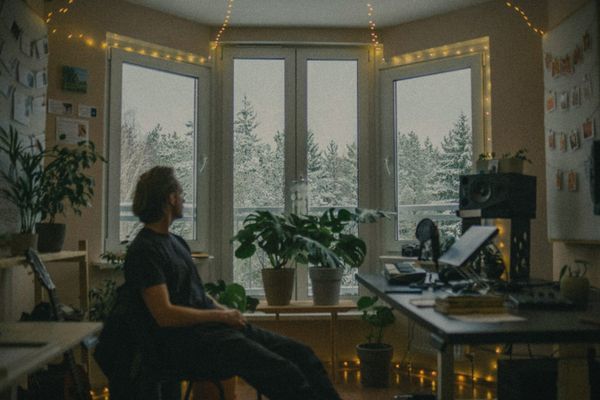
Wired and Tired: Why Burnout Leaves You Exhausted but Unable to Sleep
High-functioning burnout doesn't just exhaust you — it keeps you wired at night. Here's why the two coexist, and what actually shifts it.
It's midnight. You've been awake since six, barely made it through dinner, and you've been counting the hours until you could lie down. Now you're lying down. And your mind is going at full speed.
This is the wired-and-tired paradox: a central feature of burnout. Your body is depleted. Your nervous system is not. The exhaustion you feel doesn't translate into sleep because your stress-response system is still active, still scanning, still holding the alert signal live, even after the day is done.
When burnout keeps you exhausted but unable to sleep, the mechanism is a stress-response system that's been running without a proper off switch. The tired and the wired coexist because they come from different systems operating on different timetables. Until you understand what's driving each one, the usual sleep advice will keep missing the point.
Why your nervous system doesn't know the day is over
Cortisol follows a natural daily rhythm. It peaks in the morning to help you get going, drops through the day, and falls to near-zero by evening so that melatonin can take over and sleep can begin. In an unstressed body, this cycle runs fairly reliably.
Chronic stress disrupts it. Under sustained pressure, cortisol levels stay elevated into the evening. The HPA axis (the hormonal system governing your stress response) remains in a kind of sustained-alert mode. Not irrationally: from the body's perspective, the pressure hasn't let up, so it keeps the signal live.
The result is a body that is genuinely depleted but a nervous system that remains activated. Heart rate stays slightly elevated. Thoughts keep moving. Senses stay primed for whatever might still need handling. You lie down, and your brain reads the stillness as an opportunity to process everything it held at bay during the day.
This is distinct from ordinary insomnia. The activation is physiological, and it won't respond to willpower or to the familiar instruction to "just relax."
The trap that deepens it
There's a feedback loop buried in this pattern. Sleep deprivation impairs the prefrontal cortex, the part of your brain responsible for regulating stress reactivity. So as you accumulate poor nights, your capacity to calm your own nervous system deteriorates. Each difficult night makes the next one harder to break.
People in this cycle often describe lying awake cataloguing what's undone, or a single low-stakes thought looping on repeat, or an ambient hum of alertness with nothing specific wrong. These are different expressions of the same state: a nervous system that accumulated activation through the day and has nowhere to discharge it.
Some also notice a paradoxical second wind in the evenings. Shattered by four o'clock, then somehow more alert at nine or ten. If that's familiar, it fits the same disrupted cortisol pattern. An afternoon crash followed by an evening spike is one of the more reliable early markers of this kind of dysregulation. There's a longer look at how that deterioration develops in Quiet Cracking Has a Name Now.
What doesn't help
A few things people try in good faith that tend to make it worse.
Staying in bed hoping sleep arrives. Lying awake for extended periods trains your brain to associate the bed with wakefulness. Sleep researchers call this conditioned arousal, and it adds a learned layer on top of the original physiological problem.
Applying effort to relax. The instruction "I need to switch off now" lands on your nervous system as urgency. You're applying pressure to a system that responds to pressure by staying alert. It reads the demand, not the intent.
Alcohol. It sedates initially, but fragments sleep architecture after the first few hours. The 3am wake-up, hot and mildly wired, is frequently alcohol's contribution.
Only addressing the hour before bed. This is perhaps the most common mistake. The state you bring to bedtime reflects the whole day's accumulation, not the last sixty minutes of it. A wind-down routine applied to a fully activated nervous system is like opening a window to cool a room while the heating is still on.
What actually shifts the activation
The target isn't relaxation as a mental state. It's discharging the physiological activation that's keeping your sympathetic nervous system live. These are different goals, and they call for different tools.
Extended exhale breathing. A longer exhale than inhale engages the parasympathetic branch of the autonomic nervous system, which supports a calming response and reduces physiological stress markers. A simple starting ratio: four counts in, six to eight counts out. Five minutes of this, done sitting somewhere other than bed before you intend to sleep. The point isn't to feel calmer on the spot; it's to send a physiological signal.
Movement before the evening ends. Your stress response is designed to conclude in physical action. When it doesn't because you've been still all day, the activation remains chemically present in your body. A short walk outside, even ten minutes, allows some of this to complete. Not exercise for its own sake. A signal.
A consistent wind-down anchor. One small, invariable thing done the same way each night. The ritual builds a conditioned stimulus-response pattern over weeks of repetition, and it won't do much on night one. What you're building is an association, not a feeling.
The same principle that applies to micro-recoveries during the day applies here: smaller, repeated interventions over time outperform occasional large efforts. Burnout-related sleep disruption typically takes several weeks of consistent practice to stabilise, and sometimes longer.
The longer view
The wired-and-tired pattern is a burnout symptom that surfaces at night, because night is when the day's stimulation falls away and the nervous system's accumulated state becomes visible. Treating it only at bedtime gets you partway there.
The actual leverage is what happens during the day: physical movement, breaks that genuinely interrupt the stress signal rather than just pause it, and enough space in the working hours for your body to receive the message that the alert doesn't need to stay live. Not to perform better the next morning. To keep the nervous system from treating ordinary Tuesdays as ongoing emergencies.
Sleep is not where recovery happens. It's where recovery becomes possible once the groundwork has been laid.
If you want to read more as we publish, you can sign up for updates at mindbodyzen.co.uk.
Frequently Asked Questions
Why am I always exhausted but can't sleep at night?
The most likely explanation is a stress-response system that's been chronically activated. Your body is depleted from sustained demands; your nervous system is still running the alert signal it's been running all day. These two states can coexist because they involve different systems. Depletion and physiological activation aren't opposites, and bedtime routines alone won't resolve the underlying pattern.
How long does burnout-related sleep disruption take to improve?
It depends on how long the stress has been building and what changes in daily habits. A single good weekend or a better bedtime routine won't shift a dysregulated HPA axis on its own. With consistent daily practices targeting nervous system regulation across the whole day, not just before sleep, most people begin to notice improvement after three to six weeks. Fuller recovery usually takes longer, and the work is more about what you do during the day than the hour before bed.
Is wired-and-tired the same as burnout?
Wired-and-tired describes a specific symptom rather than burnout itself: the combination of chronic exhaustion with an inability to fully switch off or sleep. It's a reliable early marker, particularly in people who are still delivering at work and appearing functional. Recognising this pattern is worth taking seriously as a signal that your stress-response system needs attention before the broader picture of burnout sets in further.
Every new article, in your inbox.
Practical, warm, evidence-minded. No streaks, no guilt.